
 EU (English)
 DE (Deutsch)
 FR (Français)
 UK (English)
Burnt Larch Cladding for Façades?
Martin Gottschlich
Siberian Larch vs. Japanese Cedar (Sugi) – Which Timber is the Better Fit for Your Home Exterior?
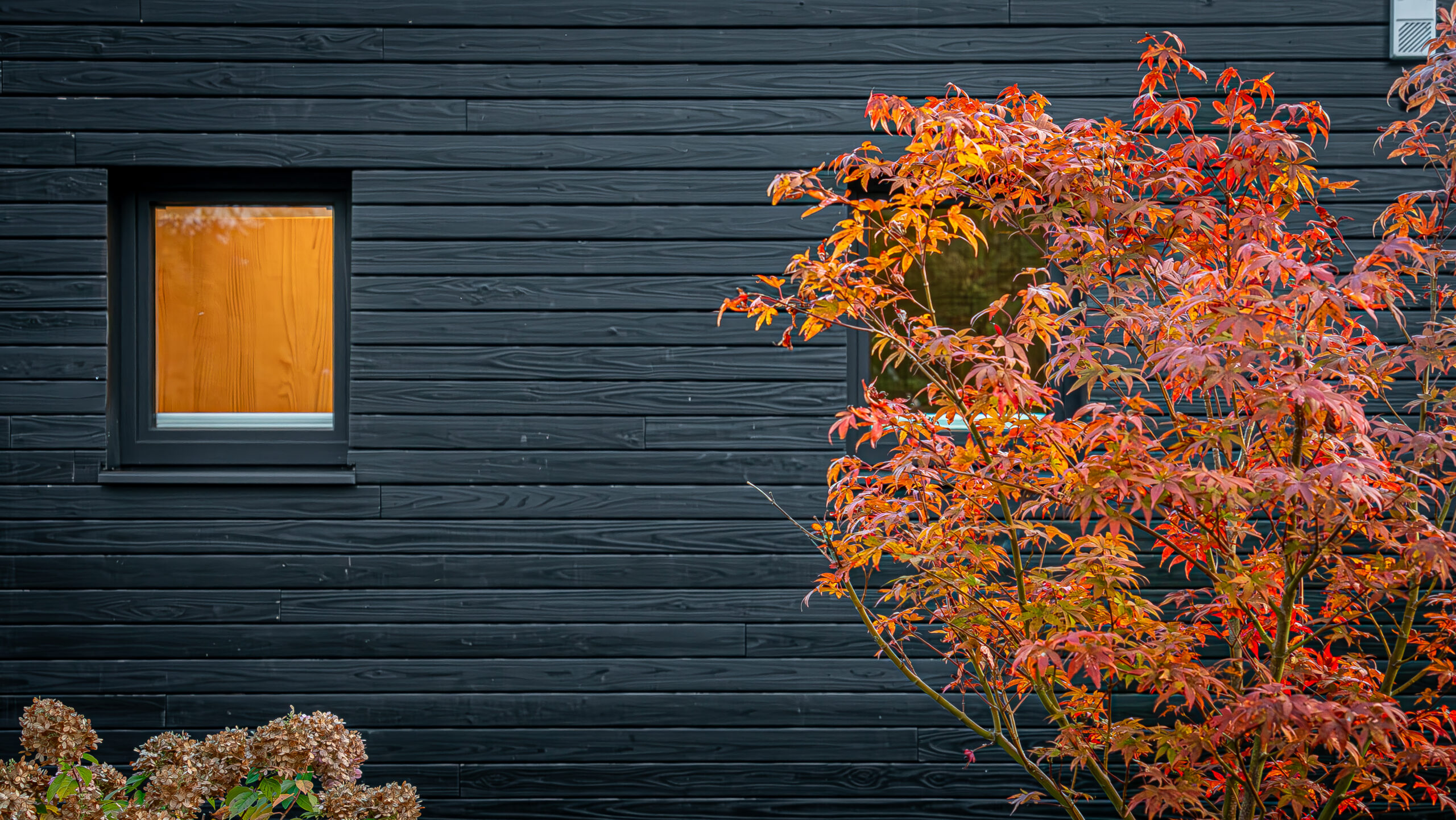
Timber façades never go out of style. A charred timber surface adds depth and character to contemporary architecture. Yakisugi — a building material made from charred Japanese cedar — is gaining traction across Europe, offering a visually compelling and highly durable façade option. This article compares two popular choices: charred Siberian larch and authentic Yakisugi, across durability, sourcing, maintenance, and long-term value.
Sourcing and Legal Status
Both Siberian larch and Japanese cedar are used for timber façades in Europe. Siberian larch has historically been valued for its robustness and slow growth in cold climates. However, since the 2022 sanctions against Russia, its direct import into the EU has been banned. It frequently enters the market via third countries such as Turkey or Kazakhstan, raising both legal and ethical concerns. Major certification bodies including FSC and PEFC have officially classified Russian and Belarusian timber as conflict wood, making Siberian larch no longer a compliant option for certified projects. Many public tenders have banned it outright.
Japanese cedar (Sugi) is the most common tree species in Japan, which has over 68% forest coverage. Nakamoto Forestry’s own forests cover around 2,000 hectares in Hiroshima Prefecture, certified to PEFC/SGEC standards (certificate JIA-022 / CEFC 1901). The chain of custody for Nakamoto Forestry Europe is independently verified by TÜV Nord (certificate 44 702 200728). Environmental performance is documented through an EPD according to ISO 14025 Type III (certificate JR-BC-2001E).

Siberian Larch vs. Japanese Cedar (Sugi) — Key Properties
| Siberian Larch | Japanese Cedar (Sugi) | |
|---|---|---|
| Botanical name | Larix sibirica | Cryptomeria japonica |
| Density | approx. 550–650 kg/m³ | approx. 380 kg/m³ |
| Resin content | High | Naturally resin-free |
| Dimensional stability | Moderate | Excellent |
| Durability class (untreated) | Class 3–4 | Class 2–3 |
| Durability class (after charring) | No established data | Class 1–2 |
| Availability in Europe | Severely restricted since 2022 sanctions | Fully available |
| Long-term façade data | Less than 10 years for most charred products | Documented use since the 18th century |
Charred Larch vs. Genuine Yakisugi
Both larch and Sugi can be charred to improve resistance to UV radiation, moisture, and biological degradation. But the results are not equivalent.
The term “Yakisugi” refers specifically to charred Japanese cedar — not larch. Despite this, several European manufacturers market charred larch cladding as “Yakisugi,” which is factually incorrect. Yakisugi is a building material with documented use in Japan since the 18th century. Charred larch cladding, by contrast, is a recent product: most European charred larch products are less than 10 years old, and no long-term durability data exists for the material.
Nakamoto Forestry has refined the production of Yakisugi over generations. The charring process heats the entire board in a controlled manner — achieving a carbonised layer that acts as a natural barrier against moisture, UV radiation, and pests, without any chemical wood preservatives.


Traceability and Ethical Sourcing
Nakamoto Forestry is a family-owned company based in Hiroshima Prefecture, Japan. For every tree harvested, a new sapling is planted. The full supply chain — from forest to European distribution — is traceable and third-party certified.
The sourcing situation for Siberian larch is considerably less transparent. With direct imports banned since 2022, material entering the European market via third countries may not meet the traceability requirements of certification schemes or public procurement rules. Buyers should request proof of origin and current certification status before specifying the material.
Verified Quality & Sustainable Forestry
We encourage all buyers to request proof of origin to ensure they’re receiving a sustainable, high-quality product. Nakamoto Forestry owns and manages forests in Japan with over 100 years of sustainable practices. For every tree harvested, a new sapling is planted, preserving the forest for future generations.
Major environmental certifications like FSC and PEFC have officially listed Russian and Belarusian timber as “conflict wood,” making Siberian larch no longer a legal option.

Surface Treatment
Yakisugi requires no chemical wood preservatives. The carbonised surface layer provides natural protection. On request, boards are coated at Nakamoto Forestry Europe’s facility near Düsseldorf: with solvent-free oils based on linseed and tung oil, with water-based stains, or — for heavily used interior spaces — with a water-based lacquer system. Semi-transparent finishes only — the visible grain and charred texture are always preserved.
Charred larch products frequently require chemical sealants to compensate for lower natural durability. Treatments vary significantly between manufacturers. Always request full specifications before procurement.

Maintenance Comparison at One Glance
| Charred Siberian Larch | Authentic Yakisugi | |
|---|---|---|
| Maintenance cycle | Every 5–10 years | Every 5–10 years if colour retention desired |
| Maintenance process | Cleaning, sanding, priming, staining, repainting | Oil or stain application only — no sanding or priming required |
| Untreated ageing | Prone to uneven greying and cracking | Develops a silver-grey patina gradually and evenly |
| Long-term track record | No data beyond ~10 years | Documented since the 18th century |

One of Yakisugi’s key advantages is its low maintenance. Unlike burnt larch, for which no long-term durability studies exist (many products are less than 10 years old), authentic burnt cedar cladding from Japan has centuries of proven performance.
Charred larch, particularly Siberian, is prone to uneven greying, cracking, and frequent upkeep. Without maintenance, the façade loses structural integrity and visual appeal over time. Treatments may be required every 5 to 10 years, including cleaning, sanding, priming, staining, and repainting.
Burnt cedar Yakisugi, however, remains intact even untreated. Brushed finishes age beautifully, developing a silver-grey patina slowly and gracefully. Colour maintenance – if desired – can be done every 5 to 10 years with oil or stain, requiring no sanding or priming.
Cost Efficiency & Longevity
Our Yakisugi is treated without any synthetic wood preservatives. Surface colours can be enriched or sealed with natural oils or water-based stains only.
In contrast, imitation burnt larch cladding often involves various chemical sealants, especially if not naturally durable. These additional treatments can raise concerns about environmental impact and longevity. Always inspect the specs and treatments used in any charred larch or imitation Yakisugi.

Why Authentic Yakisugi Wins
While burnt larch can provide a charred aesthetic, only burnt cedar Yakisugi has stood the test of time. Japanese Sugi combines natural durability, low resin content, and superb dimensional stability—making it the perfect timber for this technique.
There is still no long-term data on the durability of charred larch cladding, and significant quality variation makes consistent comparison impossible.
Conclusion: Which Timber Façade Should You Choose?
For specifiers and homeowners weighing charred timber façade options, the differences are significant:
- Sourcing: Siberian larch is legally restricted across the EU since 2022. Yakisugi from Nakamoto Forestry is fully certified and traceable.
- Durability: Yakisugi reaches durability class 1–2 post-charring. No equivalent data exists for charred larch.
- Maintenance: Both require attention every 5–10 years, but Yakisugi needs no sanding or priming.
- Track record: Yakisugi façades have been documented in Japan since the 18th century. Charred larch cladding has been on the European market for less than a decade.
If you’re specifying a cladding solution that is sustainable, traceable, and built for the long term, Yakisugi from Nakamoto Forestry is the documented choice.
Interested? Give us a ring:
+49 211 86 80 86 60