
 EU (English)
 DE (Deutsch)
 FR (Français)
 UK (English)
 IT (Italiano)
 ES (Español)
Yakisugi Deep Dive: Timber Origin, Production Process and Environmental Data
Martin Gottschlich
Yakisugi and the Environment: Forest Origin, Production and CO₂ Figures at a Glance
Yakisugi is a traditional Japanese cladding material produced without chemical wood preservatives — using controlled charring alone. This article covers the key facts on timber origin, production process, carbon footprint, and certifications.
Timber as a Renewable Building Material and Carbon Sink
Among the major building materials used in Europe — concrete, brick, steel, glass, asphalt, plaster, natural stone, and timber — only timber is a renewable natural resource. Unlike steel, brick, or concrete, it is not synthesised from raw materials through energy-intensive industrial processes.
Forests absorb and store significant quantities of carbon from the atmosphere. Key figures:
- 1 m³ of timber weighs on average 500 kg, of which 50% is carbon — equivalent to 250 kg of carbon per m³
- 250 kg of carbon converts to approximately 917 kg of CO₂ (at 3.67 kg CO₂ per kg of carbon)
- Yakisugi stores approximately 15 kg CO₂ equivalent per m² for as long as the timber remains in place
- Production generates 2.1 kg CO₂ equivalent per m², according to the Environmental Product Declaration (EPD Type III, ISO 14025, no. JR-BC-2001E)
Sustainably Sourced Timber
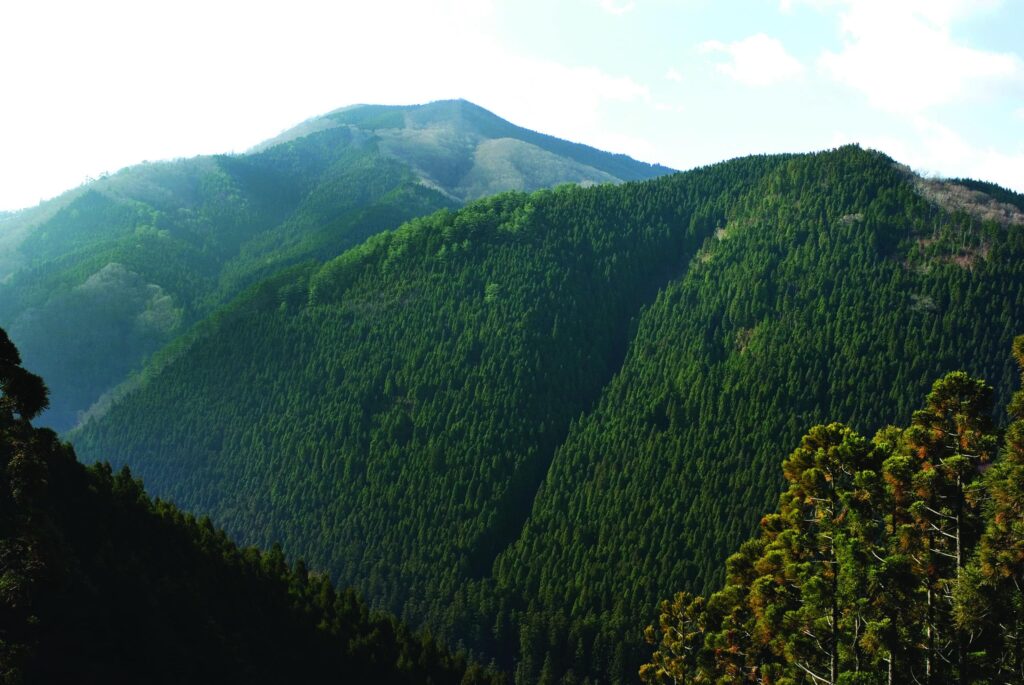
Nakamoto Forestry’s Yakisugi is produced predominantly from timber harvested in the Nakamoto family’s own forests in Hiroshima Prefecture. The forests have held SGEC certification since 2006 and PEFC certification since 2019 (certificate JIA-022 / CEFC 1901).
Nakamoto Forestry Japan holds PEFC Chain of Custody certification covering production in Japan. Nakamoto Forestry Europe holds PEFC Chain of Custody certification verified by TÜV Nord since 2020 (certificate 44 702 200728), covering distribution in Europe.
Key facts about forest management:
- Forest area: over 2,000 hectares in Hiroshima Prefecture
- Forest age: many stands planted at the company’s founding are now over 60 years old
- Management cycle: target rotation of 100 years; clear-cutting is avoided
- Thinning timber: primarily used, with immediate replanting after harvest
- Infrastructure: own tree nursery for seedlings and saplings; own forester’s workshop for ongoing maintenance including pruning, thinning, and snow damage removal
- Watershed protection: forests near the headwaters of the Ota River are managed with measures to prevent sediment entering water resources downstream
- Recognition: Emperor’s Cup awarded at the Festival of Agriculture, Forestry and Fisheries in November 1989 (forestry category)
Nakamoto Forestry, together with other forestry companies in the region, founded the Ota-gawa SGEC network to promote a circular regional economy based on local resources.
The Senryo Mountain, managed by Nakamoto Forestry, holds particular ecological significance: approximately half is covered by natural mixed forest of deciduous trees and natural cedar, with a designated seed-tree forest preserving the Hachirou-Sugi mother tree. The forest is used for training and education of timber groups, government agencies, and research institutions.


Production Process
Nakamoto Forestry uses renewable energy sources — including solar and biomass — to meet energy requirements during production. Sawdust and timber processing waste are converted into wood chips or pellets.
Before charring, timber must be dried to a residual moisture content of approximately 10–14%. Rather than kiln drying, Nakamoto Forestry relies exclusively on air and sun drying — a process that takes several weeks to months depending on the season, resulting in gentler treatment and better timber quality.
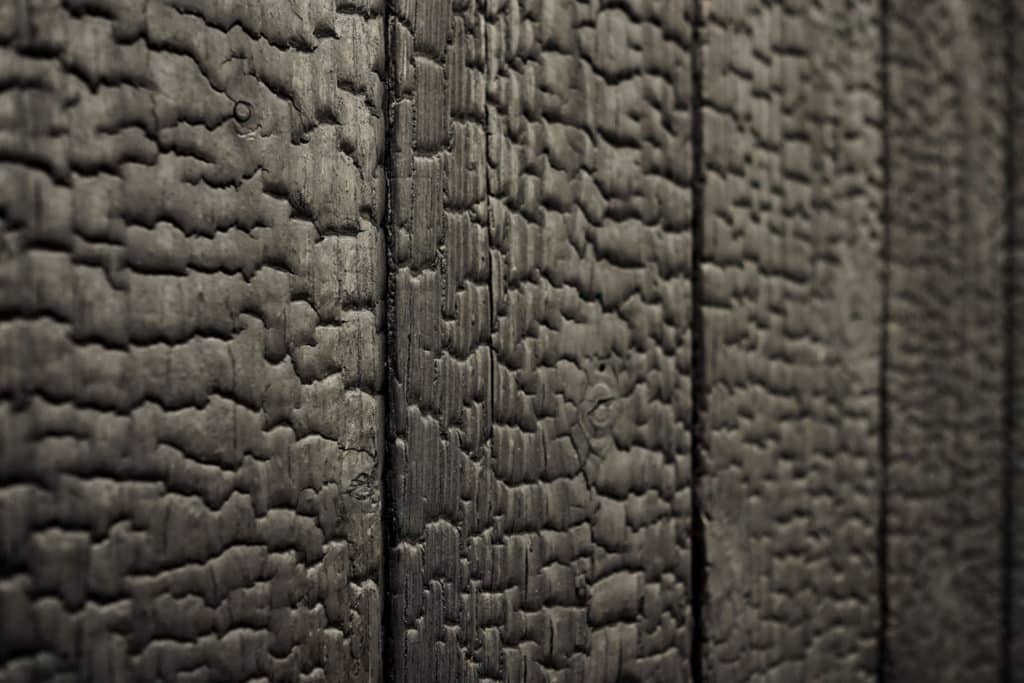
The boards are then charred in a controlled manner at very high temperature for a defined period, treating the entire board through. This full-depth heat treatment creates lasting durability — without any chemical wood preservatives. Additional efficiency measures include afterburner technology in production kilns, which reduces natural gas consumption.
On request, boards are finished at Nakamoto Forestry Europe’s facility near Düsseldorf: with solvent-free oils based on linseed and tung oil, with water-based stains, or — for heavily used interior applications — with a water-based lacquer system.
CO₂ Emissions: Production and Timber Storage
| Value | |
|---|---|
| CO₂ stored in timber | approx. 15 kg CO₂ eq. per m² (for the duration of use) |
| CO₂ from production | 2.1 kg CO₂ eq. per m² |
| Carbon per m³ of timber | approx. 250 kg (= approx. 917 kg CO₂) |
| EPD reference | Type III, ISO 14025, no. JR-BC-2001E |
The figures above show that Yakisugi stores approximately 15 kg CO₂ equivalent per m² for the duration of its use, while production generates 2.1 kg CO₂ equivalent per m² (EPD Type III, ISO 14025, no. JR-BC-2001E). With a documented service life of 60–80 years — and some façades intact for over 100 years — the material continues to store carbon throughout its useful life, and needs to be replaced far less frequently than façade materials without documented long-term durability.
Durability – Considering the Product Lifecycle
A lifecycle assessment considers all the environmental impacts of a product or material throughout its entire lifecycle, including the extraction of resources, manufacturing, use, disposal, and potentially recycling or reuse. From this perspective, we can better understand and compare the overall environmental impact of a building material.
Yakisugi timber is known for its exceptional durability and resistance to weathering, moisture and pests. The charring of the timber surface makes it resistant to rot, insect attack and fungi. This means that Yakisugi timber generally needs to be replaced far less frequently, resulting in less waste and a reduced demand for new resources.
Japanese cedar is classified as a durable timber species. Yakisugi façades in Japan with service lives of 60 to 80 years are well documented – some have remained intact for over 100 years. The actual service life depends on construction, weathering conditions and maintenance.
Yakisugi stores approximately 15 kg CO₂ equivalent per square metre for as long as the timber remains in place. Due to its documented service life, it needs to be replaced far less frequently than conventional façade materials – reducing the demand for new resources over its lifecycle.
Certifications and Standards
Certifications and adherence to recognised standards play a crucial role in ensuring the traceability of our products.
Our forests and forest resources in Hiroshima Prefecture have held SGEC (Sustainable Green Ecosystem Council) certification since 2006 and PEFC (Programme for the Endorsement of Forest Certification) certification since 2019. Nakamoto Forestry, together with other forestry companies in the region, founded the Ota-gawa SGEC network to promote activities that create a circular regional society making use of local resources.
Our entire supply chain is also PEFC-certified. Nakamoto Forestry Europe received Chain of Custody (CoC) certification in 2020 (TÜV Nord 44 702 200728), covering the entire product chain from the forest through processing in Japan to delivery to our central warehouse in Europe.
Further certifications include Environmental Product Declarations (Type III, ISO 14025, no. JR-BC-2001E) for all our product lines, as well as our certification as a recognised forestry enterprise under Japanese forestry law for sustainable forest management.

| Certification | Detail |
|---|---|
| SGEC forest certification | Since 2006, Hiroshima Prefecture |
| PEFC forest certification | Since 2019, certificate JIA-022 / CEFC 1901 |
| PEFC Chain of Custody (Japan) | Nakamoto Forestry Japan, covering production in Japan |
| PEFC Chain of Custody (Europe) | Since 2020, TÜV Nord, certificate 44 702 200728, covering distribution in Europe |
| EPD | Type III, ISO 14025, no. JR-BC-2001E |
| Japanese forestry law | Certified forestry enterprise under Japanese forestry law |
Interested? Give us a ring:
+49 211 86 80 86 60