
 EU (English)
 DE (Deutsch)
 FR (Français)
 UK (English)
How to Identify Authentic Yakisugi — and Why It Matters

Dinah Woltermann
Original vs. Fake Shou Sugi Ban
Not all charred wood is Yakisugi. The term has travelled far from its origins in Japan, and in that journey, it has been applied to products that share the aesthetic but not the substance. For anyone specifying a façade material that is expected to perform for decades, the difference matters considerably.
This article sets out what defines authentic Yakisugi — and what disqualifies an imitation.
It Begins with the Wood
Yakisugi is a building material made from charred Japanese cedar. The name itself makes this clear: Yaki (焼) means burnt; Sugi (杉) is the Japanese cedar tree, Cryptomeria japonica. The two are inseparable — not by convention, but by material logic.
Japan is one of the world’s most densely forested industrialised nations, with 68.4% of its land area covered by forest. Within those forests, Sugi is the dominant species, comprising 44% of Japan’s total forest stock. It has been harvested, processed, and built with for centuries — and its particular combination of properties is precisely what makes the charring process work.
Sugi is a softwood with low density (380 kg/m³) but exceptional dimensional stability. It is virtually resin-free, which allows the charring process to produce an even, consistent surface without the unpredictable combustion that resin pockets cause in other species. Its annual rings are hard and relatively dense, providing the structural foundation for a soot layer that can last for decades without maintenance. And its natural tannin content provides inherent resistance to insects and mould — before any charring takes place.
Other species can be charred. But the result is not Yakisugi — and the performance is not comparable.

The Board Dimensions That Make Charring Work
The charring process used in authentic Yakisugi production is not a surface treatment. It is a full-board heat treatment: the entire thickness of the board must be penetrated by heat for the material to acquire the durability and rot-resistance that define genuine Yakisugi.
This creates a precise constraint on board dimensions. Yakisugi boards must not exceed 15 mm in thickness.
This is not an arbitrary specification. Consider what happens outside this limit:
- Too thick: Achieving full penetration requires excessive heat input. At that level, the surface of the wood begins to degrade — breaking down rather than carbonising. The result is what practitioners call white charring: the wood burns, weakens, and loses structural integrity. The surface is destroyed before the core is treated.
- Too thin: Less of a structural risk, but boards under a certain thickness lack the mechanical resilience required for exterior cladding.
For context: standard European timber cladding boards typically run 18–24 mm thick. Yakisugi boards, at 15 mm, are thinner by design — optimised for the heat treatment, not in spite of it.
Before charring begins, the boards must also be dried to a residual moisture content of 10–14%. Boards that are too moist cannot form a stable, long-lasting charcoal layer. At Nakamoto Forestry, this drying is done exclusively through air and sun — a process that takes weeks to months depending on the season, but results in a gentler, more consistent treatment than kiln drying.
The Degree of Charring — A Common Misconception
A persistent misconception in the European market holds that Yakisugi products differ from one another in their degree of charring — light char, medium char, deep char. This framing misrepresents how authentic Yakisugi is produced.
The charring depth in authentic Yakisugi production is not a variable. It is a fixed requirement: the heat must penetrate the full thickness of the board. What differs between surface finishes is not how deeply the board has been charred, but what happens after charring — specifically, whether and how the surface is brushed.
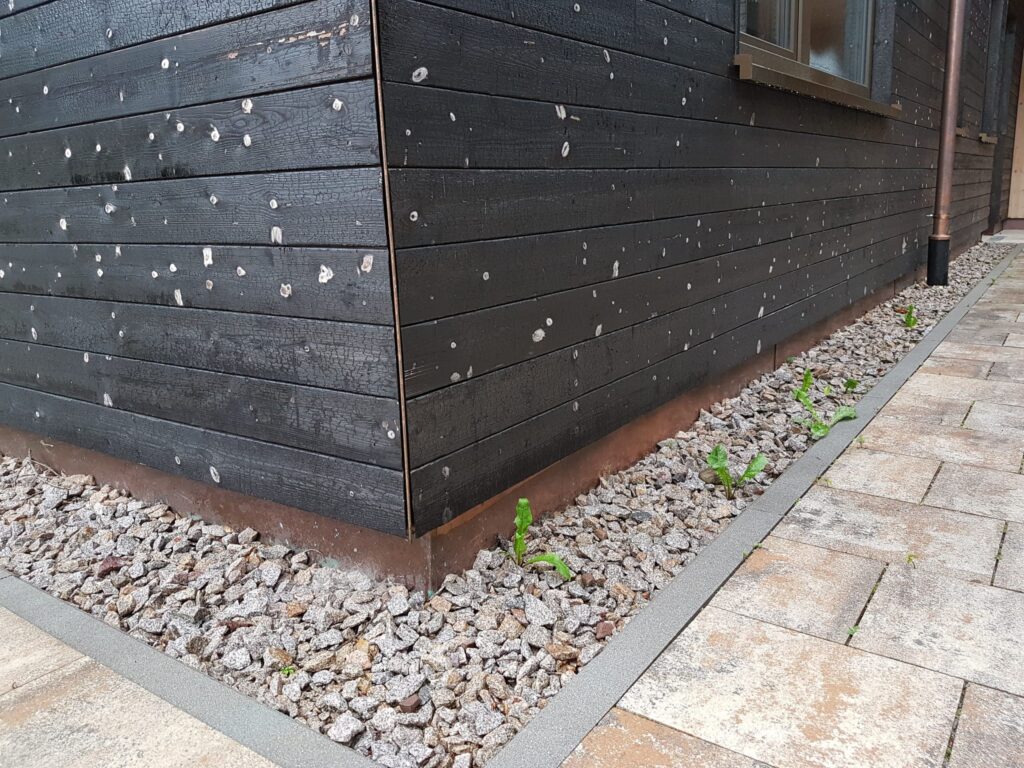
- Suyaki: The board is left as charred. The full carbonised surface remains intact.
- Gendai: The surface is lightly brushed after charring, revealing the wood grain beneath while retaining the structural benefits of full charring.
- Pika-Pika: The surface is brushed more extensively, producing a smoother finish with a pronounced grain.
In every case, the charring depth is the same. The aesthetic is a finishing choice — not a trade-off between appearance and performance.
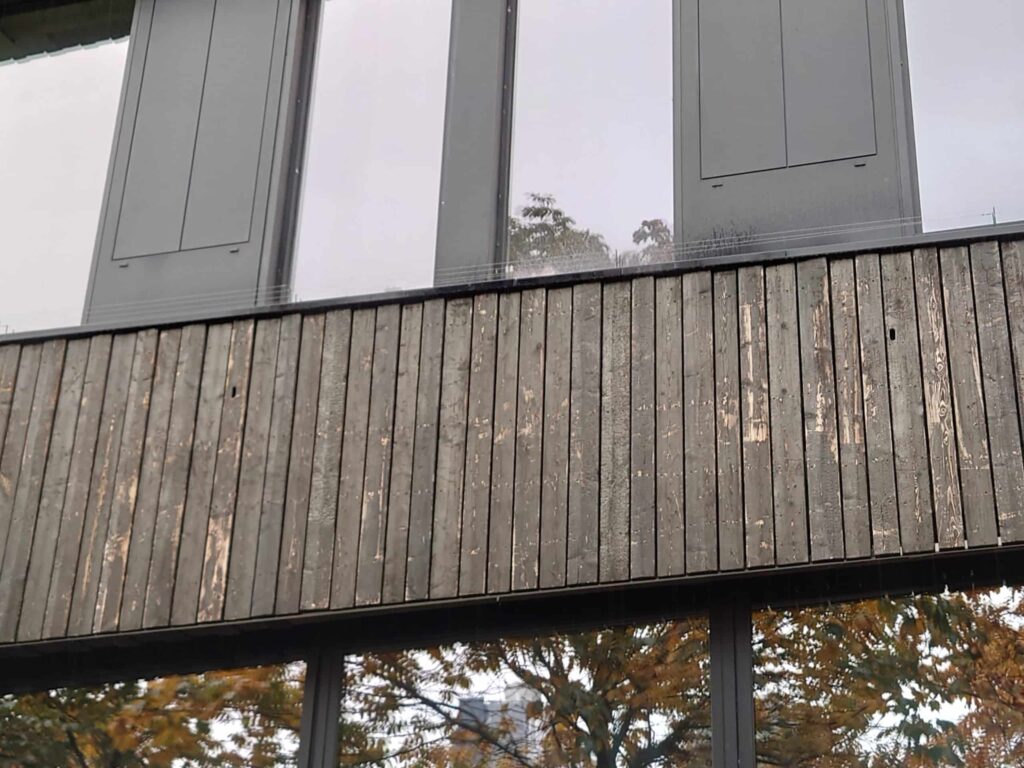
A light char applied with a blowtorch achieves something visually similar to Suyaki, but structurally it is a different material. The carbonised layer is thin and weakly bonded — comparable to gold leaf: visually present, but without depth or durability. Under weathering conditions, such a surface will typically begin to degrade and flake within a short period.
Experience as a Material Requirement
Authentic Yakisugi production requires the correct heat, duration, energy input, insertion angle, and post-treatment to follow a precise protocol. The variables are interdependent, and the margins for error are narrow. Achieving a uniform surface, a stable soot layer, and consistent penetration depth across every board is the result of decades of accumulated process knowledge — not equipment alone.
Nakamoto Forestry has been producing Yakisugi for over 60 years, backed by more than a century of forestry practice in Hiroshima Prefecture. That depth of experience is embedded in the production process — in the drying protocols, the firing systems, the sequencing of each stage.
Many European suppliers entered the charred timber market recently, as the aesthetic gained recognition in Western architecture. The visual result can appear similar. The material performance, over time, is not.
| Criterion | Authentic Yakisugi | Imitation / Light Char |
|---|---|---|
| Wood species | Japanese cedar (Sugi) only | Various species |
| Board thickness | Maximum 15 mm | Often thicker |
| Pre-charring moisture | 10–14% residual | Variable |
| Charring method | Controlled, full-board, industrial | Often blowtorch or surface-only |
| Charring depth | Full board penetration | Surface only |
| Soot layer durability | Decades without maintenance | Often flakes within years |
| Recognised in Japan | Yes | No |
Interested? Give us a ring:
+49 211 86 80 86 60